
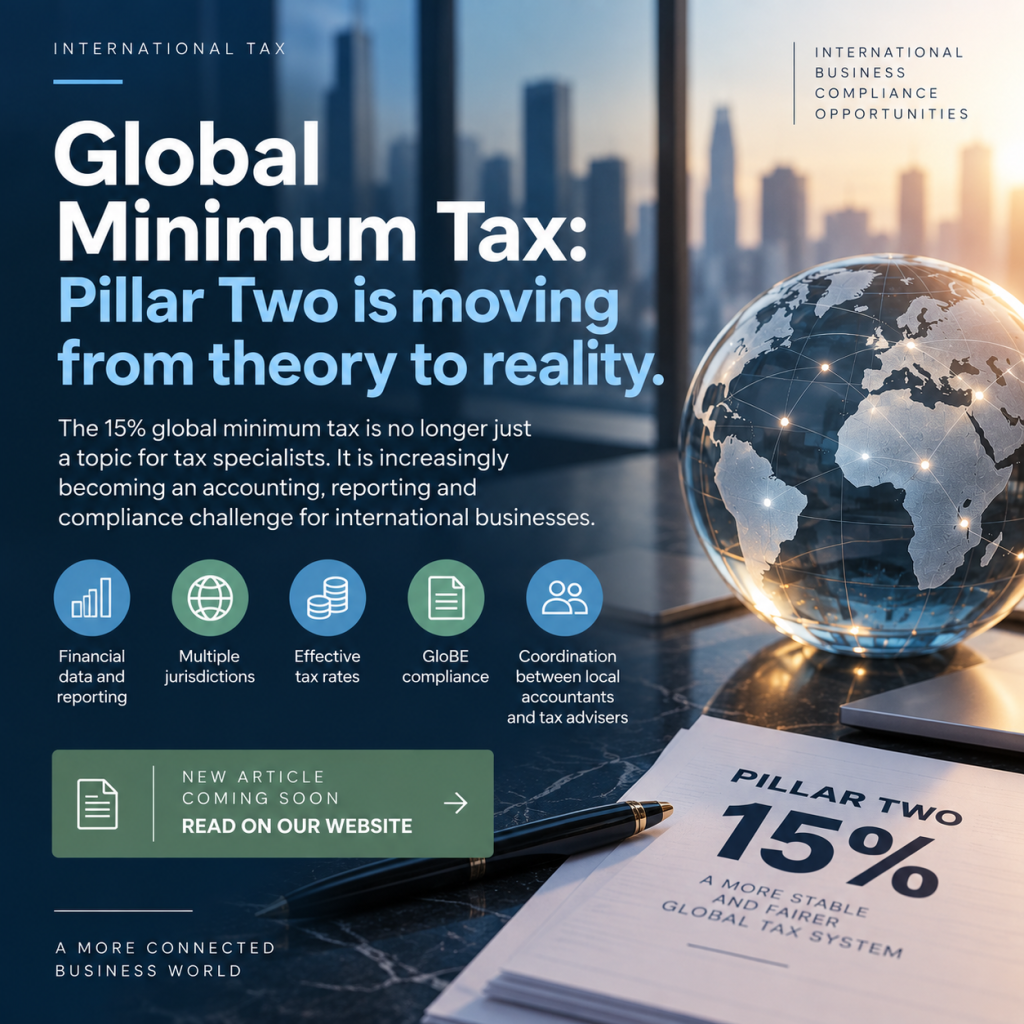
International taxation is undergoing one of its most significant transformations in decades.
For multinational businesses, the Global Minimum Tax under Pillar Two is moving decisively from policy discussion to practical implementation.
And September 2026 has brought another important development.
On 11 September 2026, the OECD/G20 Inclusive Framework on BEPS released a new package designed to strengthen the consistent implementation of the Global Minimum Tax across jurisdictions. It includes updated guidance on the GloBE Model Rules, changes to the GloBE Information Return and a framework for reviewing national legislation implementing the rules.
For multinational groups (and the accountants, tax advisers and lawyers supporting them) the message is increasingly clear:
=> Pillar Two is no longer simply an international tax concept. It is becoming an operational, accounting, data and compliance challenge.
What is “Pillar Two”?
Pillar Two forms part of the international tax reforms developed through the OECD/G20 Inclusive Framework on Base Erosion and Profit Shifting (BEPS).
At its core is a relatively simple principle: large multinational groups should generally be subject to an effective minimum tax rate of 15% in each jurisdiction in which they operate.
The detailed mechanism for achieving this is provided principally through the Global Anti-Base Erosion Rules, commonly known as the GloBE Rules.
The practical application, however, is considerably more complex than the headline 15% rate might suggest.
Which businesses are affected by the Global Minimum Tax?
The GloBE Rules generally apply to multinational enterprise groups with consolidated annual revenues of at least €750 million, subject to the detailed scope rules and exclusions.
The group must also operate internationally, through entities or permanent establishments in more than one jurisdiction. Certain categories of entity are excluded under the Model Rules.
This means Pillar Two is primarily a concern for larger international groups.
However, its importance extends beyond the businesses directly subject to the tax.
Accountants, auditors, tax advisers, finance teams and legal professionals working with multinational structures increasingly need to understand how the rules interact with financial reporting, corporate structures and cross-border operations.
How does the 15% Global Minimum Tax work?
The basic principle is to determine an effective tax rate for the multinational group in each jurisdiction where it operates.
Broadly, the relevant GloBE income or loss and covered taxes of constituent entities located in the same jurisdiction are aggregated to calculate the jurisdictional effective tax rate, or ETR.
Where that rate falls below 15%, a top-up tax may arise, subject to the detailed GloBE calculation and applicable exclusions or safe harbours. The OECD explains that the top-up percentage is essentially the difference between the 15% minimum rate and the jurisdictional ETR, with the resulting percentage applied after taking account of the substance-based income exclusion.
This jurisdiction-by-jurisdiction approach is important.
A multinational cannot necessarily compensate for a low effective tax rate in one country simply because it pays significantly more tax elsewhere.
Why Pillar Two is also an accounting issue ?
This is where Pillar Two becomes particularly relevant to the accounting profession.
Calculating the GloBE effective tax rate requires information derived from financial accounts across multiple entities and jurisdictions.
Groups may therefore need to bring together substantial amounts of information concerning income, covered taxes, entities, local financial statements and consolidated reporting.
The challenge becomes even greater when local accounting periods or standards do not perfectly align with those used for consolidated financial statements.
Indeed, the OECD’s September 2026 administrative guidance specifically addresses the application of local financial accounting standards under the Qualified Domestic Minimum Top-up Tax Safe Harbour where there are differences between the financial periods used for local accounts and those used for consolidated financial statements.
In other words, Pillar Two cannot simply sit within the tax department.
Finance and accounting teams are central to making the system work.
The GloBE Information return is becoming critical
Another important element is the GloBE Information Return (GIR).
The GIR provides a standardised framework through which implementing jurisdictions can obtain the information necessary to assess a multinational group’s liability under the Global Minimum Tax.
On 11 September 2026, the Inclusive Framework released an updated GIR incorporating simplifications agreed earlier in 2026. The revised version applies to GIR filings relating to fiscal years beginning on or after 31 December 2025.
For multinational groups, this means data management is becoming a fundamental part of Pillar Two compliance.
The question is no longer only:
“How much tax do we owe?”
Businesses increasingly need to ask:
“Do we have the information, systems and processes necessary to calculate and report it correctly across every relevant jurisdiction?”
Why international coordination matters ?
A multinational group might have its headquarters in one country, operating subsidiaries in ten others, accounting teams distributed across several jurisdictions and different external advisers supporting each entity.
Pillar Two requires those different pieces of the organisation to communicate.
Local accounting information needs to feed into group reporting.
Tax positions need to be understood across jurisdictions.
Changes to domestic legislation need to be monitored.
And information ultimately needs to be sufficiently consistent to support the group’s GloBE calculations and reporting.
This creates a coordination challenge that extends far beyond technical tax expertise.
International tax compliance increasingly depends on international collaboration.
Different countries, one global framework
One of the objectives of Pillar Two is to establish a coordinated international framework.
But implementation ultimately takes place through domestic legislation.
That creates an obvious challenge: how can businesses obtain sufficient certainty that rules implemented across many countries remain consistent with the overall GloBE framework?
The OECD’s September 2026 package addresses precisely this issue.
The Inclusive Framework has established a full legislative review process through which members can assess whether domestic Global Minimum Tax rules are consistent with the GloBE Model Rules and Commentary. Where inconsistencies are identified, recommendations can be issued.
For international businesses, greater consistency should ultimately help reduce uncertainty and unnecessary compliance complexity.
But companies still need professionals capable of understanding how the rules operate locally as well as internationally.
Pillar Two and financial reporting
The interaction between Pillar Two and financial reporting also deserves attention.
The IASB amended IAS 12 Income Taxes in 2023 to introduce a temporary exception from certain deferred-tax accounting requirements relating to Pillar Two income taxes, together with targeted disclosure requirements for affected entities.
This further illustrates why Global Minimum Tax cannot be viewed exclusively through the lens of tax compliance.
For affected multinational groups, tax teams, accountants, auditors and finance departments may all have a role to play.
What should international businesses be doing now?
For groups potentially within scope, preparation should increasingly focus on practical implementation.
Businesses should understand where their entities and permanent establishments are located, determine which jurisdictions have implemented relevant Pillar Two rules, identify the financial information required for GloBE calculations and establish clear responsibility for collecting and validating that information.
They should also consider whether existing accounting and reporting systems can provide the required data efficiently.
Perhaps most importantly, businesses should establish communication between their finance teams, accountants, tax advisers, auditors and legal advisers across jurisdictions.
Pillar Two is inherently international.
Trying to manage it as a series of isolated domestic tax exercises risks missing the bigger picture.
A new era for international tax and accounting
The Global Minimum Tax represents more than the introduction of another tax rule.
It reflects a broader transformation in the way multinational businesses are expected to manage taxation and reporting across borders.
The 15% headline rate may be relatively easy to understand.
The infrastructure required to calculate, document, report and coordinate compliance across multiple jurisdictions is not.
And that is precisely why the role of international accountants and advisers is becoming increasingly important.
At IGAL – International Group of Accountants and Lawyers, our members provide businesses with local expertise across jurisdictions while belonging to an international network built around professional relationships and cross-border collaboration.
As international tax rules become increasingly interconnected, the ability of advisers in different countries to communicate and work together becomes more valuable than ever.
Global rules require local knowledge and international coordination.