
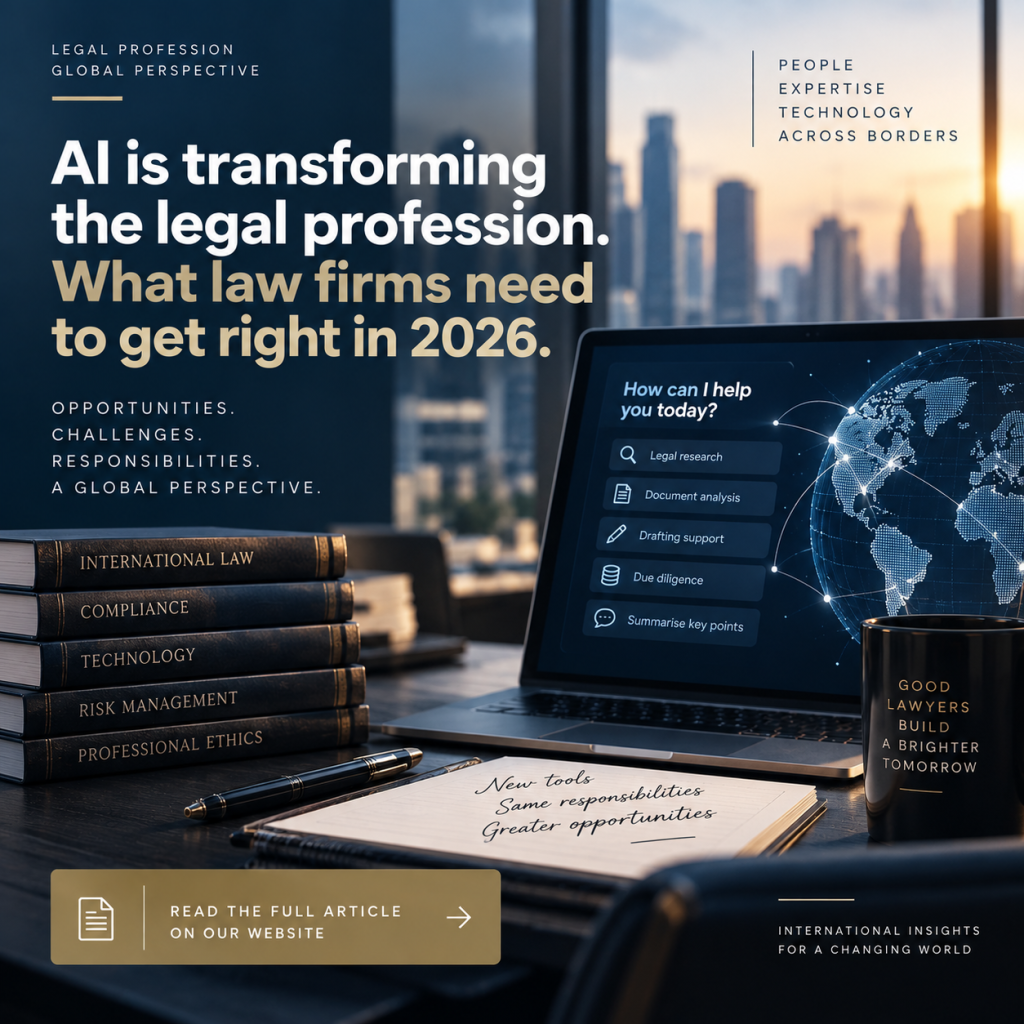
Artificial intelligence in the legal profession has reached a turning point. For several years, lawyers have experimented with generative AI for research, drafting, document review and administrative tasks. In 2026, however, the conversation is changing.
The question is increasingly no longer whether lawyers will use AI, but how law firms will integrate it responsibly into professional practice.
Recent developments illustrate just how quickly the market is evolving. Legal-specific AI products are becoming increasingly sophisticated, major international law firms are investing in proprietary systems, and technology companies are developing tools specifically designed for professional legal workflows. In September 2026, OpenAI launched a legal-focused AI offering aimed at law firms and legal technology providers, while firms including Skadden have announced new collaborations around legal AI tools.
For law firms around the world, this creates significant opportunities, but also important strategic and professional questions.
From experimentation to everyday legal work
AI is already being used across many areas of legal practice. Lawyers can use professional AI systems to assist with document analysis, legal research, contract review, due diligence, drafting and the organisation of large quantities of information.
Adoption is becoming widespread. Recent research published by LexisNexis reported that 94% of the surveyed legal professionals were using AI for legal work, with 74% using it at least weekly. The survey covered 543 legal professionals and also found growing demand for AI systems grounded in trusted legal sources.
The potential productivity gains are considerable. But productivity alone should not define a law firm’s AI strategy.
The lawyer remains responsible
One fundamental principle remains unchanged: Technology can assist the lawyer. It does not remove the lawyer’s professional responsibility. Generative AI systems can produce inaccurate information, misunderstand context or generate apparently convincing information that is simply wrong. For lawyers, the consequences can be particularly serious.
An incorrect paragraph in a marketing document is inconvenient. An incorrect legal authority submitted to a court can have professional consequences.
Regulators are therefore paying increasing attention to how lawyers use these systems. In the UK, for example, the Solicitors Regulation Authority has specifically highlighted inaccurate AI-generated information in legal documents and the risks created when confidential client information is uploaded to AI systems.
Verification must therefore remain a fundamental part of any AI-assisted legal workflow.
Confidentiality Cannot Be an Afterthought
Lawyers routinely handle some of the most sensitive information held by businesses and individuals. Contracts, litigation strategies, transactions, personal information, financial documents and privileged communications may all pass through a law firm. This makes the choice of AI technology particularly important.
Before using any system with client information, firms need to understand where information is processed, whether it may be retained, how access is controlled and whether the tool has been approved for professional use within the firm. The convenience of a consumer AI application should never override professional confidentiality obligations.
Clients are beginning to expect more
AI is not only changing how lawyers work. It is also changing what clients expect from their lawyers.
According to Thomson Reuters’ 2026 research, 32% of surveyed in-house legal professionals were already reconsidering relationships with law firms that did not demonstrate clear AI-enabled value within the following 12 months.
This creates an interesting challenge. Clients may expect firms to use technology to work faster and more efficiently, while simultaneously expecting absolute reliability, confidentiality and professional judgment. The competitive advantage may therefore not belong to the firm that uses the most AI. It may belong to the firm that learns where AI creates genuine value and where human expertise remains essential.
What happens to the next generation of lawyers?
There is another important question that receives less attention. Junior lawyers traditionally develop professional judgment by performing research, reviewing documents, preparing first drafts and working closely with more experienced lawyers.
AI can now perform or accelerate many of these tasks. That creates an obvious efficiency gain — but also a potential training challenge.
Thomson Reuters has highlighted concerns that automation could affect the traditional process through which younger lawyers develop judgment, client understanding and professional expertise. Law firms therefore need to rethink training alongside technology. If AI performs more of the first draft, firms must ensure that junior lawyers still learn why the final answer is correct.
AI strategy is becoming a management issue
For law firm leaders, AI can no longer simply be delegated to the IT department. It touches almost every aspect of the firm: client service, risk management, recruitment, training, profitability, cybersecurity, knowledge management and business development. The strongest AI strategies will therefore probably combine several elements:
- clear internal policies;
- approved professional tools;
- training for lawyers and staff;
- human verification;
- strong confidentiality safeguards;
- and continuous evaluation of where technology genuinely improves client service.
Technology without governance creates risk. Governance without innovation creates another risk: being left behind.
An international challenge requires international conversation
For international firms and networks, there is an additional layer of complexity. Lawyers operate under different professional rules, regulatory frameworks and legal cultures. The appropriate use of AI in one jurisdiction may not necessarily correspond exactly to professional expectations in another. That makes international dialogue increasingly important.
Networks such as IGAL – International Group of Accountants and Lawyers provide an opportunity for independent firms around the world to exchange experiences, compare approaches and learn how colleagues in other jurisdictions are responding to technological change. The future of legal practice will undoubtedly involve more technology. But the fundamental value of the profession remains remarkably familiar: judgment, trust, expertise and relationships.
AI can strengthen all four. It should never replace them.